Service Provider
Definition
The Service Providers are standard applications that rely on Identity Providers to let the users log in.
Join federation
To join the federation, the service provider management team must deliver its "Metadata". The service provider Metadata describes how the service providers behave:
- Which security algorithms does it support.
- The public portion of its signing and encrypting keys.
- The SAML protocol does it support.
- The URL of each SAML protocol endpoint.
- Contact information.
Standard attributes
TheTo standardsee attributesmore dependinformation onabout the Serviceservice providerproviders type.
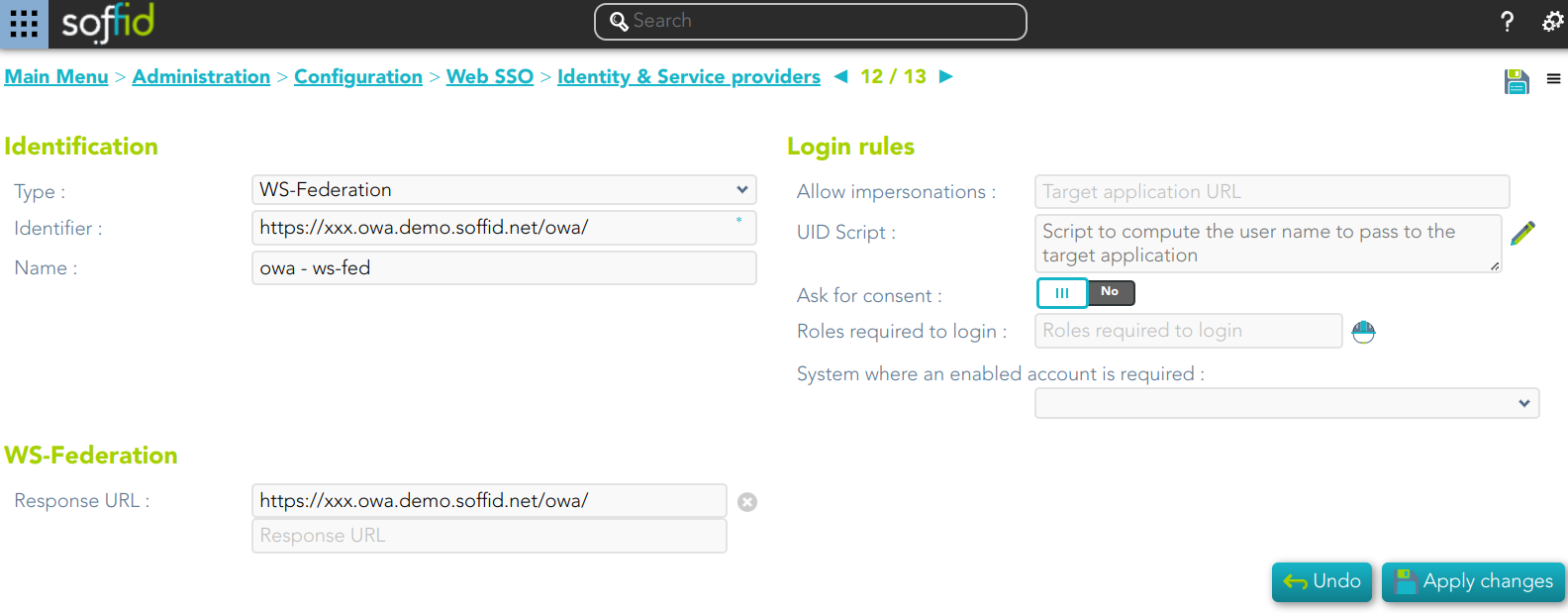
SAML
and To enable External SAML protocolattributes, you can visitcheck the AuthenticationService providers page. Also, on that page you could download the metadata XML file.
Identification
Identifier: public name of the service provider. It must be uniqueName: friendly user name or brief description.
Service configuration
Metadata: you must provide the identity provider metadata. You can either copy it from the Soffid Identity Provider page, or instruct the service provider to download the federation metadata by itself.NameID format:PersistentEmailUnspecifiedTransient
To publish the federation members' metadata, the main sync server exports the member's metadata at the path /SAML/metadata.xml. Thus, if your sync server is listening at soffid1.your.domain, you can get the whole federation metadata document from:
https://soffid1.your.domain:760/SAML/metadata.xml
After some seconds, up to five minutes, every federation member will notice any change.
Login rules
Allow impersonations: Soffid allows a service provider to connect to another service provider in a controlled manner. Here you can write the target application URL.UID Script: script to compute the user name to pass to the target applicationAsk for consentRoles required to login: roles that the user must have to be able to connect to the systemSystem where an enabled account is required: System where it will be necessary for the user to have an account in order to log in.
💻 Image
You can visit the Openid-connect to SAML interoperability page for more detailed information.
SAML API client
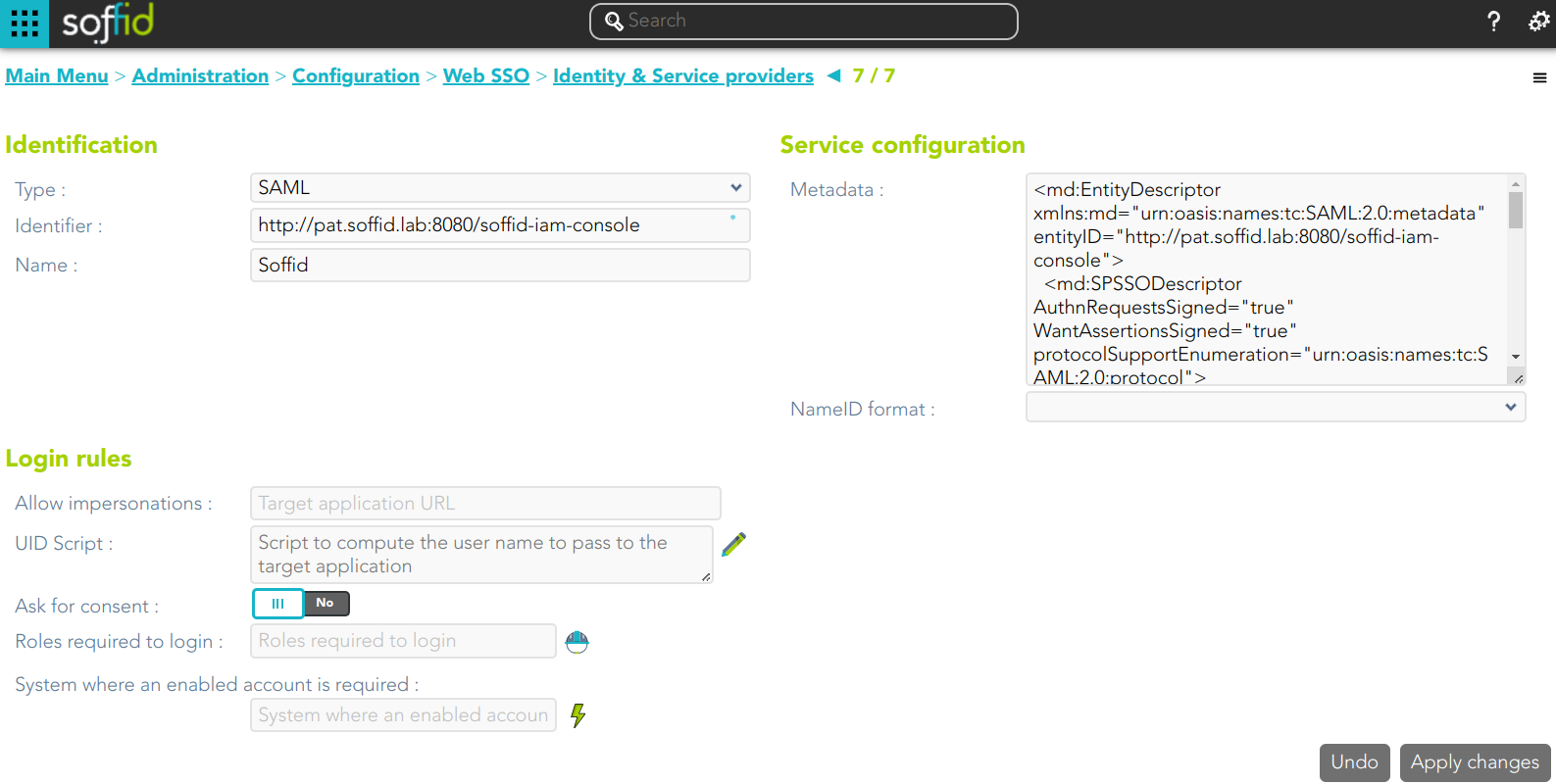
Identification
Identifier: public name of the service provider. It must be uniqueName: friendly user name or brief description.Organization: company name of the external IdP.Contact: email address of the external IdP.
Service configuration
MetadataNameID format:PersistentEmailUnspecifiedTransient
Leave it blank as Soffid IdP will fulfill it for you.
The metadata will be created when the network data and SAML Security data.
Login rules
Allow impersonations: Soffid allows a service provider to connect to another service provider in a controlled manner. Here you can write the target application URL.UID Script: script to compute the user name to pass to the target application.Ask for consent
You can visit the Openid-connect to SAML interoperability page for more detailed information.
Network
Host name: public application host name that wants to be a service provider. A fully qualified name should be used.Standard port: public application port number.Disable SSL: check it, selected value Yes, if you want to use plain TCP connections. In another case, it will be needed to comply with additional fields:Assertion path: URL to receive the response.
SAML Security
PublicKey:Clicking on theGenerates public / private keybutton, a new private key pair will be generated. Once the private key pair is generated, you could generate a certificate request file, also known as PKC#10 or CSR file. The certificate authority will be able to create a certificate for you using this certificate request. Once you have created the public/private key, you could run other new functions:Change public/private key: this allows you to change the public/private key generated previously.Delete public/private key: this allows you to delete the public/private key generated previously.Generate PKCS10: generates a PKCS10 file (Certification request standard).
Clicking on theUpload PKCS12 filebutton it will be able to upload a PKCS#12 file. That file must contain the private and public keys and the server certificate as well. Mind that PKCS#12 file use to be protected by a PIN.
Certificate chain: text certificate chain created with one of the previous options.
💻 Image
OpenID Connect
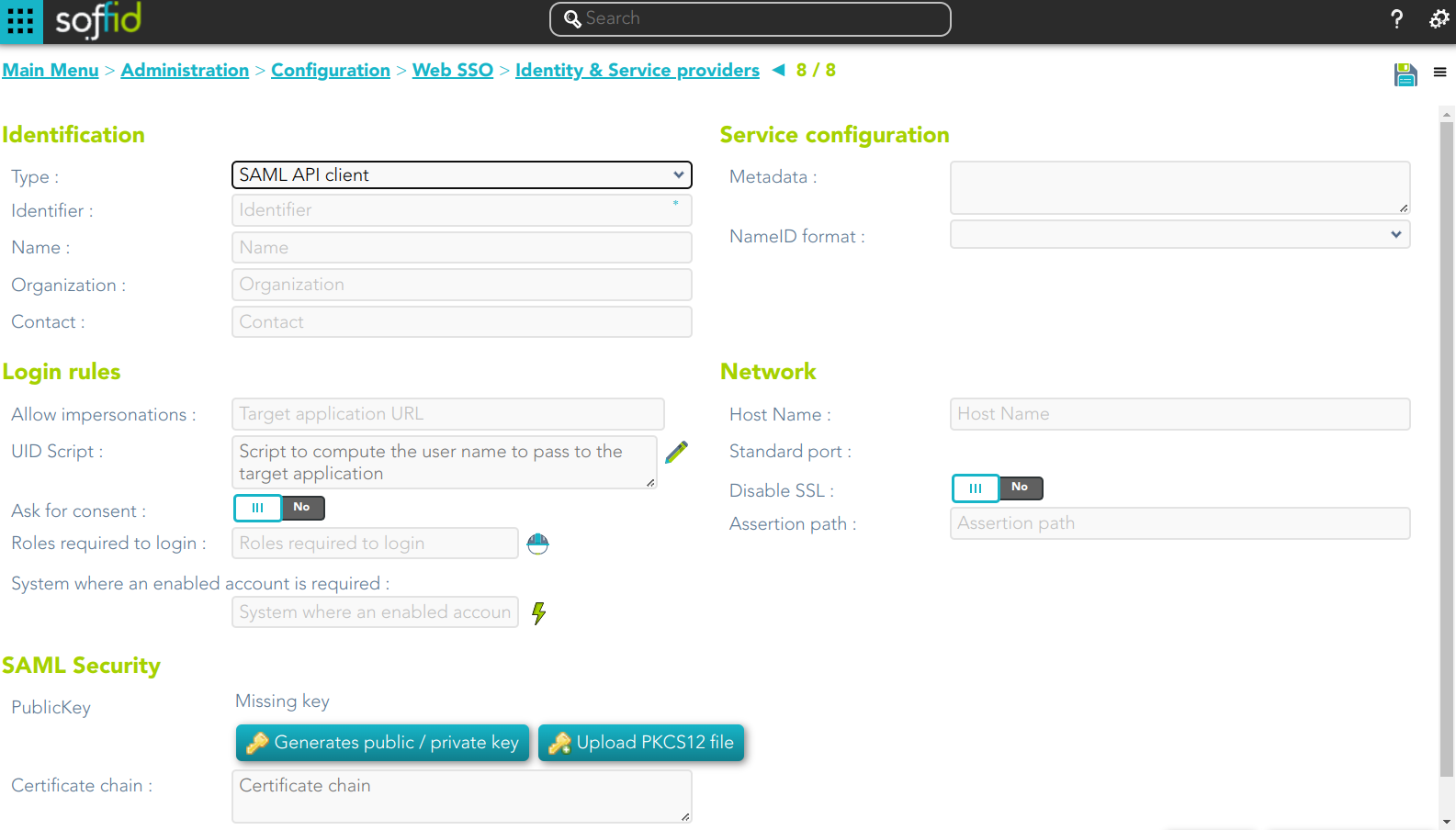
Identification
Identifier: public name of the service provider. It must be unique.Name: friendly user name or brief description.
Login rules
Allow impersonations: Soffid allows a service provider to connect to another service provider in a controlled manner. Here you can write the target application URL.UID Script: script to compute the user name to pass to the target application.Ask for consentRoles required to login: roles that the user must have to be able to connect to the systemSystem where an enabled account is required: System where it will be necessary for the user to have an account in order to log in.
You can visit the Openid-connect to SAML interoperability page for more detailed information.
OpenID authorization flow
Implicit: application server redirects the end user to the IdP, that in turn, returns the oAuth token along with the OpenID token.Authorization code: application server redirects the user to the IdP, which in turn, returns an authorization code that can be used to retrieve the token and the OpenID token from the token endpoint.User's password: the server access directly to the token endpoint, sending the username and password, to retrieve the oAuth and OpenID token. This mechanism is highly insecure, as allows unauthenticated clients to impersonate end usersUser's password + Client credential: it is a secure version of the previous one, requiring the client to use its client secret.Client id: the identifier used by the application server.Client secret: password used by the application server. It is used in the Authorization code flow as well as “User’s password + Client credentials” flow.Response URL: set the URL to return the control after authenticating a user.RP-Initiated logout response URL'sFront-channel logout endpointBack-channel logout endpointoAuth Session timeout (secs): time in seconds that will take the oAuth session. The oAuth has its own life cycle, regardless of the session timeout.Allowed scopes: you can define a scope list with the proper scopes that users will need to interact with the final system.openid: default scope.custom scopes: you can add the custom scopes that can be requested by the service provider.*: the scope * means that any scope requested by the service provider will be granted.
💻 Image
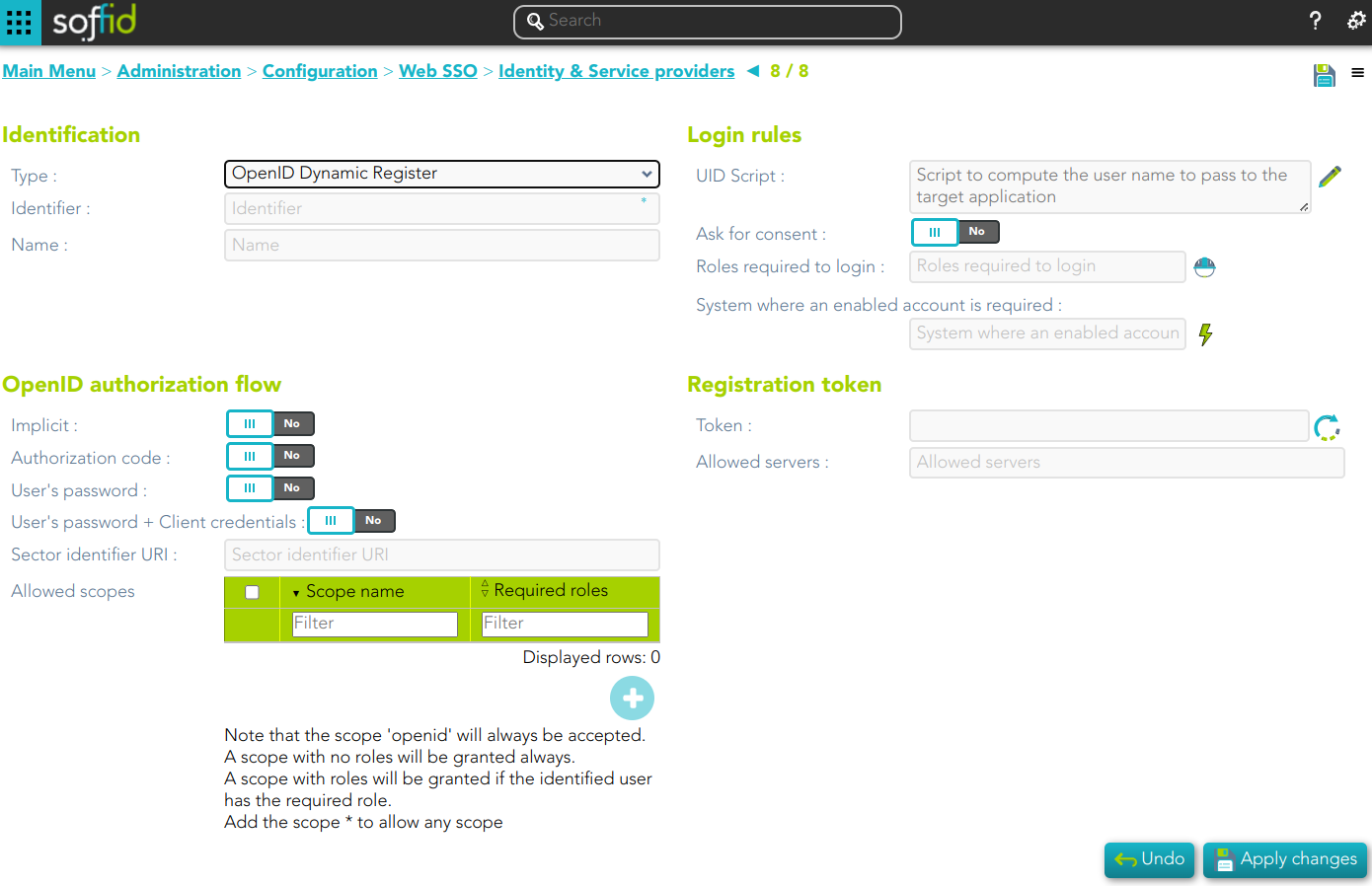
OpenID Connect Dynamic Registration
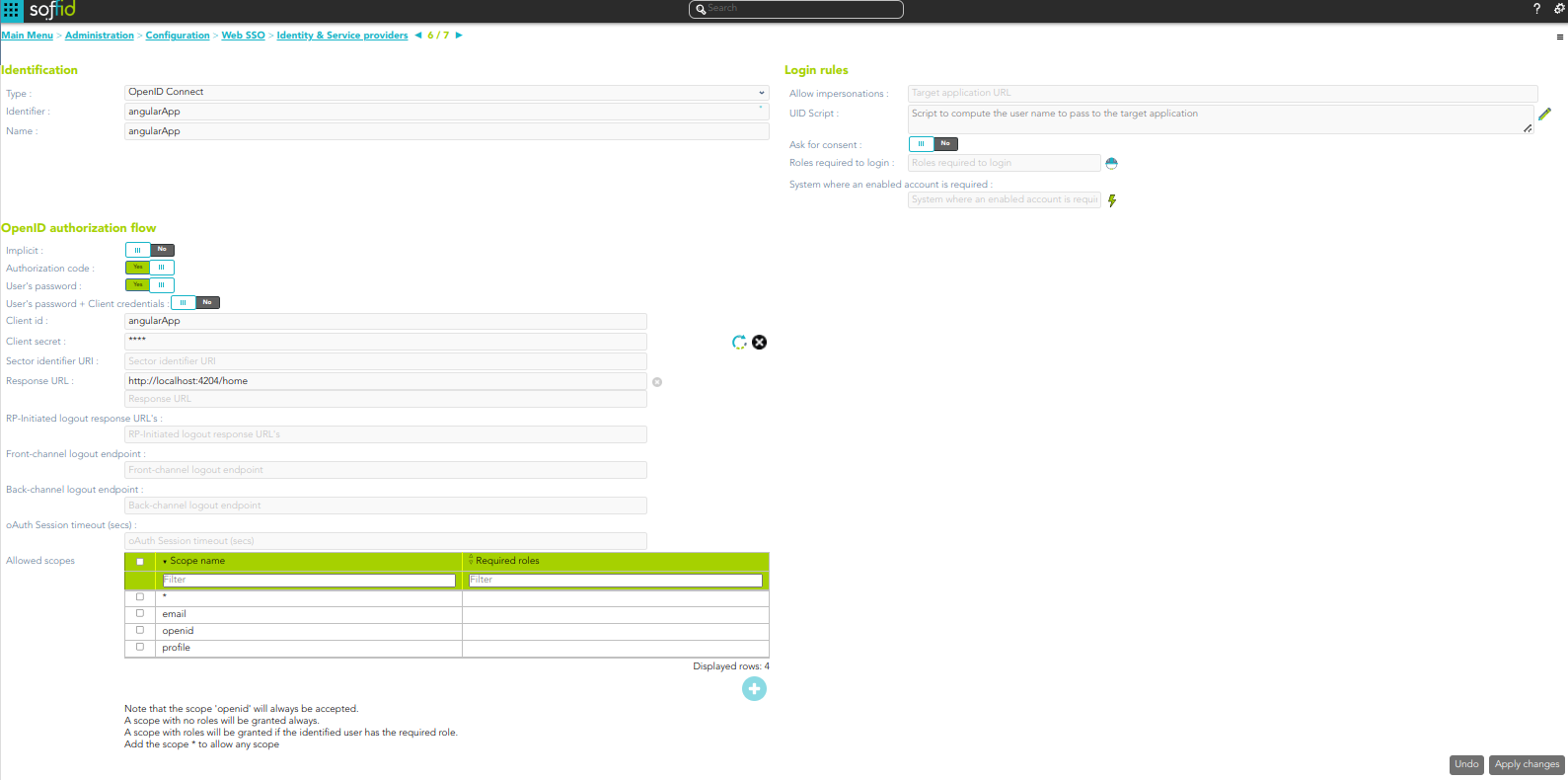
Identification
Identifier: public name of the service provider. It must be uniqueName: friendly user name or brief description.
Login rules
UID Script: script to compute the user name to pass to the target application.Ask for consentRoles required to login: roles that the user must have to be able to connect to the system.System where an enabled account is required: System where it will be necessary for the user to have an account in order to log in.
OpenID authorization flow
Implicit: application server redirects the end user to the IdP, that in turn, returns the oAuth token along with the OpenID token.Authorization code: application server redirects the user to the IdP, which in turn, returns an authorization code that can be used to retrieve the token and the OpenID token from the token endpoint.User's password: the server access directly to the token endpoint, sending the username and password, to retrieve the oAuth and OpenID token. This mechanism is highly insecure, as allows unauthenticated clients to impersonate end usersUser's password + Client credential: it is a secure version of the previous one, requiring the client to use its client secret.Sector identifier URIAllowed scopes: you can define a scope list with the proper scopes that users will need to interact with the final system.openid: default scope.custom scopes: you can add the custom scopes that can be requested by the service provider.*: the scope * means that any scope requested by the service provider will be granted.
Registration token
Token: unique identifierValid until: maximum validity dateAllowed servers: maximum number of servers that can be registered
💻 Image
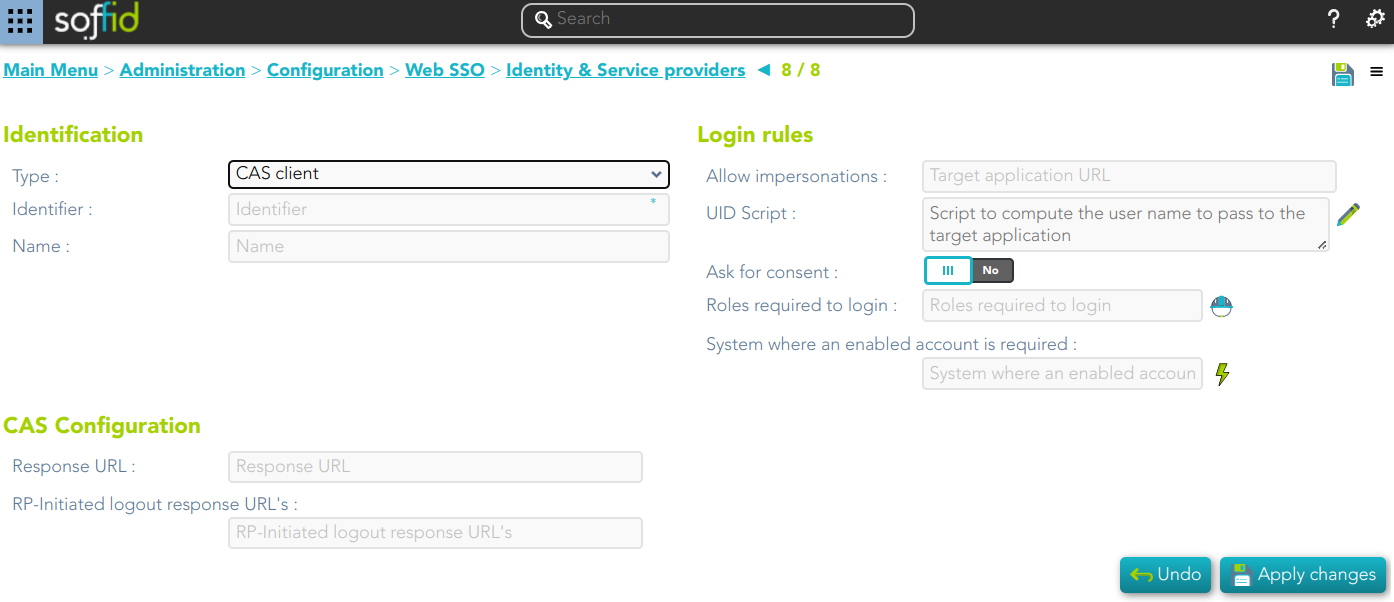
Cas client
Identification
Identifier: public name of the service provider. It must be unique.Name: friendly user name or brief description.
Login rules
Allow impersonations: Soffid allows a service provider to connect to another service provider in a controlled manner. Here you can write the target application URL.UID Script: script to compute the user name to pass to the target application.Ask for consentRoles required to login: roles that the user must have to be able to connect to the systemSystem where an enabled account is required: System where it will be necessary for the user to have an account in order to log in.
CAS configuration
Response URLLogout response URL
💻 Image
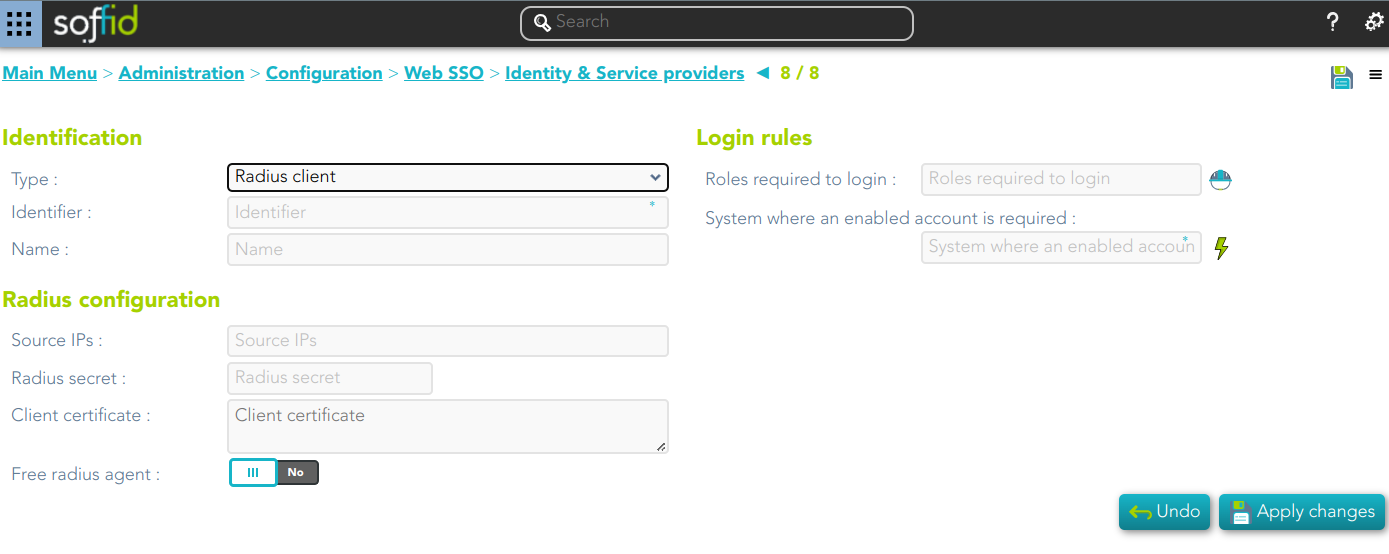
Radius client
Identification
Identifier: public name of the service provider. It must be unique.Name: friendly user name or brief description.
Login rules
UID Script: script to compute the user name to pass to the target application.Roles required to loginSystem where an enabled account is required
Radius configuration
Source IPs: origin IP or origin IP range.Radius secret: password
💻 Image
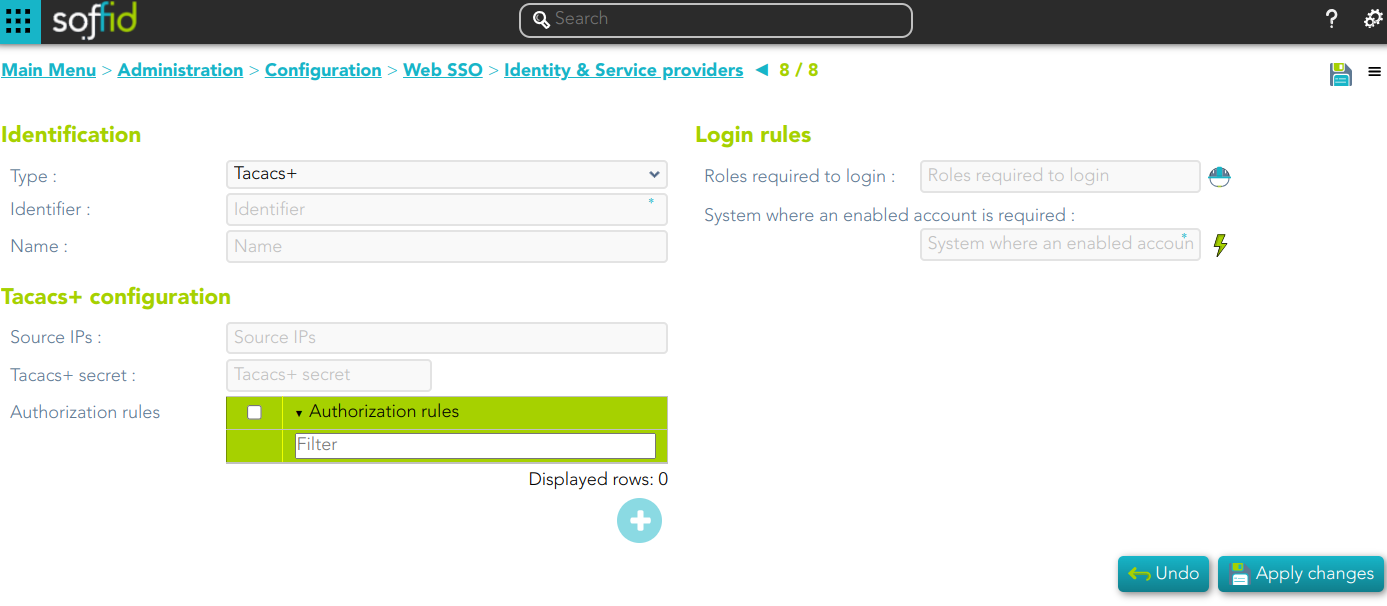
TACACS+
Identification
Identifier: public name of the service provider. It must be unique.Name: friendly user name or brief description.
Login rules
Roles required to loginSystem where an enabled account is required
Tacacs+ configuration
Source IPs: origin IP or origin IP range.Tacacs+ secret: password.Authorization rules: allows you to add additional authorization rules to elevate privileges. Available context variables:user: remote user namepriv_level: privilege levelremote_address: remote addressport: portoptionalArguments: modifiable map of optional attributes.mandatoryArguments: modifiable map of mandatory attributes.returntrue if the action is authorized.
💻 Image
https://www.rfc-editor.org/rfc/rfc8907.html
WS-Federation
Identification
Identifier: public name of the service provider. It must be unique.Name: friendly user name or brief description.
Login rules
Allow impersonations: Soffid allows a service provider to connect to another service provider in a controlled manner. Here you can write the target application URL.UID Script: script to compute the user name to pass to the target application.Ask for consentRoles required to login: roles that the user must have to be able to connect to the systemSystem where an enabled account is required: System where it will be necessary for the user to have an account in order to log in.
WS-Federation
Response URL